The 'swamp monster' of the Tremembé Formation (Taubaté Basin, Brazil; late Oligocene): a description of a carnivorous metatherian (Sparassodonta, Proborhyaenidae)
DOI:
https://doi.org/10.4072/rbp.2025.2.0534Abstract
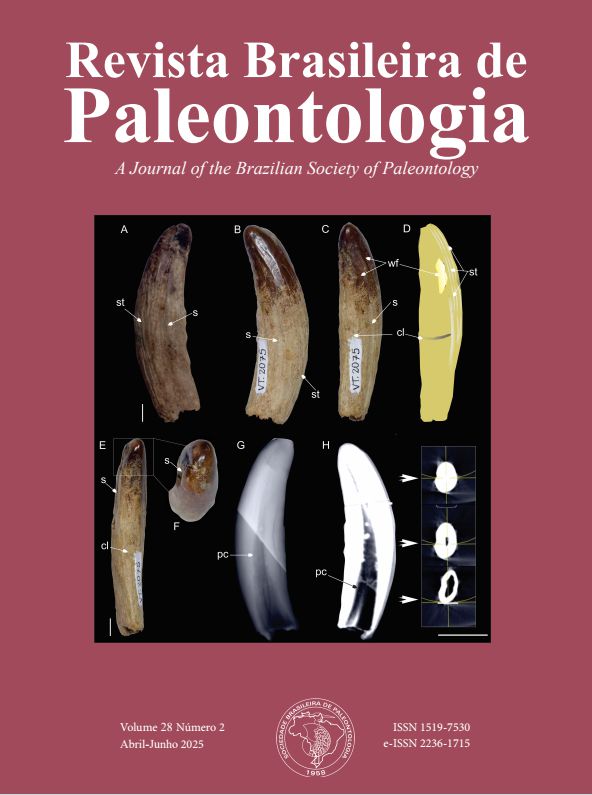
Sparassodonta is an extinct clade of South American metatherians that occupied the role of carnivorous predators on the continent during the Cenozoic Era. The Oligocene was a significant period for the diversification of several mammalian lineages, being the time when the largest sparassodonts, such as several Proborhyaenidae evolved. Among the known localities with fauna from this epoch, the Taubaté Basin (late Oligocene, Deseadan SALMA), located in the State of São Paulo, southeastern Brazil, is the only one from Brazil dated to this period. The fauna from this locality is represented by Metatheria, Chiroptera, Rodentia, Cingulata, Astrapotheria, Litopterna, Notoungulata, and Pyrotheria. Here, we describe specimen MHNT.VT.2075, a lower canine of a large sparassodont from this fauna. This canine is assigned to the Proborhyaenidae based on the presence of an open root and labial and lingual midline sulci. This record increases the diversity of large mammals in this locality. Overall, the Tremembé Formation is a significant geological and paleontological resource that provides valuable insights into the final stages of the Paleogene period in intertropical South America.
Keywords: Paleogene, sulci, procumbence, canine, phylogenetic analysis.
Downloads
Downloads
Additional Files
Published
How to Cite
Issue
Section
License
Copyright (c) 2025 Caio César Rangel, Graziella do Couto-Ribeiro, Bruno Maurício Grachien Guimarães, Edison Vicente Oliveira, Elizabeth Höfling

This work is licensed under a Creative Commons Attribution-NonCommercial-NoDerivatives 4.0 International License.
This is an Open Access article distributed under the terms of the Creative Commons Attribution-NonCommercial-NoDerivatives license (http://creativecommons.org/licenses/by-nc-nd/4.0), which permits non-commercial re-use, distribution, and reproduction in any medium, provided that no alterations are made and the original article is properly cited. The written permission of Revista Brasileira de Paleontologia must be obtained before any commercial use and/or adaptation of the article.