Skip to main content
Skip to main navigation menu
Skip to site footer
Open Menu
Home
Current
Archives
About the Journal
Editorial Team
Submissions
Contact
Privacy Statement
Search
Register
Login
Search
Contact
Home
/
Archives
/
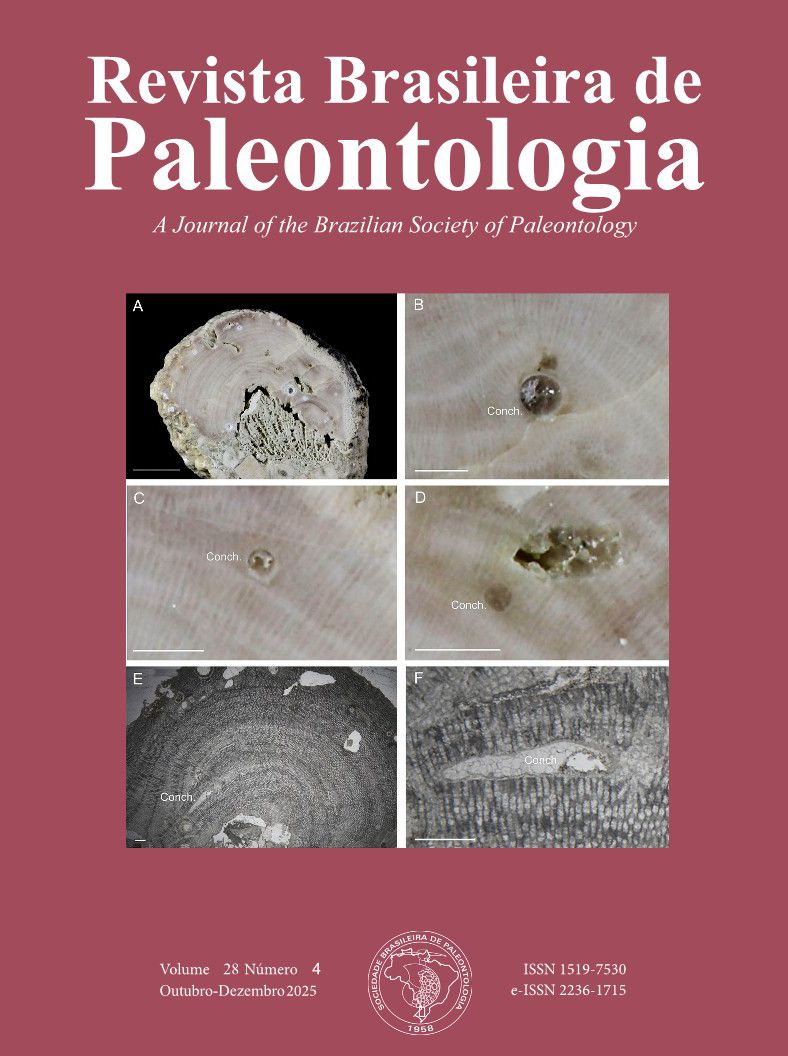
Vol. 28 No. 4 (2025): Revista Brasileira de Paleontologia
Vol. 28 No. 4 (2025): Revista Brasileira de Paleontologia
Published:
2026-06-30
Articles
Glyptotherium cylindricum (Xenarthra, Glyptodontidae) en el Cinturón Transvolcánico, Estado de Puebla, México
Zaid Lagunas-Rodríguez, Francisco Javier Jiménez-Moreno, Francisco Cuadrelli, Alfredo Eduardo Zurita, Sergio Suarez-Cruz, Gerardo Carbot-Chanona
e20250520
pdf (Español (España))
DOI:
https://doi.org/10.4072/rbp.2025.4.0520
Body mass estimation for Neoglyptatelus uruguayensis Fernicola et al., 2017 (Mammalia, Cingulata, Pachyarmatheriidae)
Ezequiel García, Rudemar Ernesto Blanco, Andrés Rinderknecht
e20250536
pdf
DOI:
https://doi.org/10.4072/rbp.2025.4.0536
The first record of endobiotic cornulitids in a heliolitid coral from the Hirnantian (Late Ordovician) of Estonia
Olev Vinn, Magdy El Hedeny, Abdullah Alkahtane, Saleh Al Farraj
e20250548
pdf
DOI:
https://doi.org/10.4072/rbp.2025.4.0548
Paleoclimatic and vegetation reconstruction of the last 22,000 years of western Santa Catarina (Brazil) studied by pollen records
Ivan Luís Kirchner Eidt, Mirian Carbonera, Gisele Leite de Lima Primam, Jefferson Nunes Radaeski, Soraia Girardi Bauermann, Guilherme Luiz Girardi, Cristina Gouvêa Redin, Daniel Loponte
e20250550
pdf
DOI:
https://doi.org/10.4072/rbp.2025.4.550
Taphonomy in Brazil: over 36 years of history and new insights
Hermínio Ismael de Araújo-Júnior, Laís Alves-Silva, Ronaldo Araujo Leoni
e20250570
pdf
DOI:
https://doi.org/10.4072/rbp.2025.4.0570
Language
English
Español (España)
Português (Brasil)
Make a Submission
Make a Submission
Visitors
Browse