Paleoenvironment of Taenidium barretti from the Middle Devonian Old Red Sandstones of Estonia
DOI:
https://doi.org/10.4072/rbp.2025.1.0542Resumen
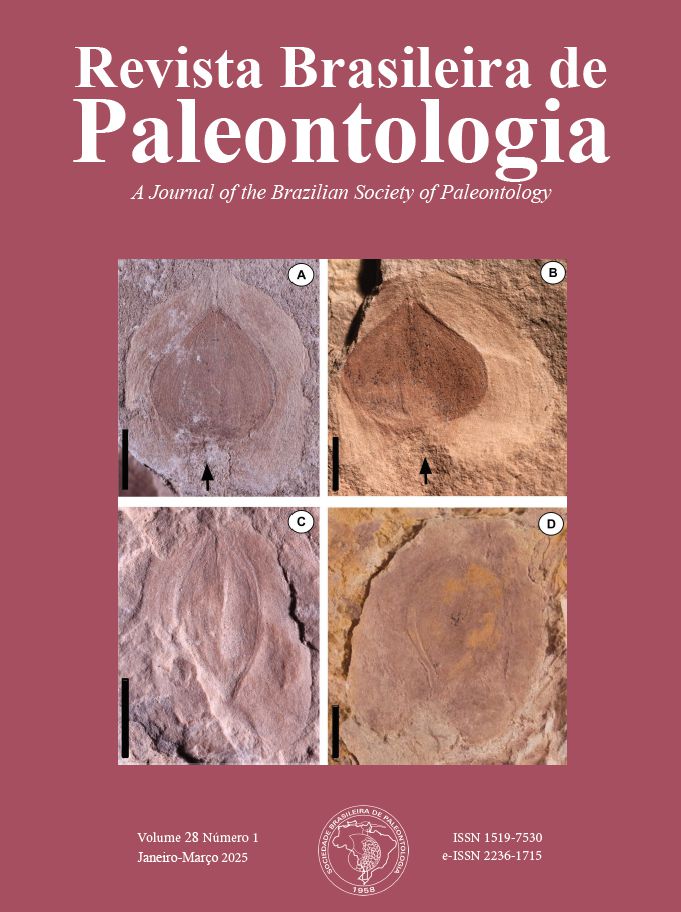
Trace fossils are good indicators of paleoenvironment and help us to re-evaluate the contradicting paleoenvironmental setting of the Middle Devonian Old Red Sandstones in Estonia. In this paper, the first ichnofossils are systematically described from the Eifelian of southern Estonia and the eastern Baltic in general. Taenidium barretti (Bradshaw) is abundant in laminated siltstone at two horizons. Eifelian sandstones also contain rare Planolites isp. These traces were most likely produced by deposit- or detritus-feeding worms or small arthropods. The main difference between the two tracemakers was in the lack of sediment push-back in the case of Planolites isp. The lack of sediment push-back in Planolites isp. resulted from the different locomotor behavior of the animal and not from the sediment’s material properties, which were similar in the case of both traces. There could have been two species of deposit-feeding invertebrates in the Eifelian of Tamme, though a single organism producing different traces could not be ruled out. The discovered traces are either characteristic of
nonmarine environments (T. barretti) or are facies-crossing traces that occur in nearly all depositional environments (Planolites isp.). The trace fossils at Tamme suggest that the paleoenvironment was a fluvially dominated, subaqueous delta plain environment, as suggested by previous sedimentological studies, but contrary to studies based on fossil fish.
Keywords: trace fossils, delta plain, nonmarine environment, terrigenous sedimentation, Eifelian, Baltics.
Descargas
Descargas
Publicado
Cómo citar
Número
Sección
Licencia
Derechos de autor 2025 Olev Vinn, Radek MIKULÁŠ, Mare Isakar, MAGDY EL HEDENY, Mansour Almansour, SALEH AL FARRAJ

Esta obra está bajo una licencia internacional Creative Commons Atribución-NoComercial-SinDerivadas 4.0.
This is an Open Access article distributed under the terms of the Creative Commons Attribution-NonCommercial-NoDerivatives license (http://creativecommons.org/licenses/by-nc-nd/4.0), which permits non-commercial re-use, distribution, and reproduction in any medium, provided that no alterations are made and the original article is properly cited. The written permission of Revista Brasileira de Paleontologia must be obtained before any commercial use and/or adaptation of the article.