Sobre a Revista

Publicação da
Sociedade Brasileira de Paleontologia
Versão impressa ISSN 1519-7530    Versão online ISSN 2236-1715

A Revista Brasileira de Paleontologia (RBP) é uma publicação oficial da Sociedade Brasileira de Paleontologia e foi lançada em 2001. A revista é de acesso totalmente aberto e publica fascículos trimestrais em março, junho, setembro e dezembro.

A Revista Brasileira de Paleontologia publica artigos de pesquisa originais (tipicamente de 10 a 40 páginas de manuscrito), bem como notas taxonômicas e nomenclaturais cobrindo todos os aspectos da Paleontologia.

Os artigos devem ser escritos apenas em inglês (a partir de 2025; submissões em português e espanhol foram aceitas até 31 de dezembro de 2024). Todos os manuscritos são revisados por especialistas. Propostas para volumes de simpósios devem ser discutidas antecipadamente com os editores.

Métricas da Revista & Indexação

Fator de Impacto (JCR 2024): 0.60
Fator de Impacto de 5 Anos: 0.670
Journal Citation Indicator (JCI):  0.41
SJR (SCImago Journal Rank):  86/125 - Ciências da Terra e Planetárias (Paleontologia)
CiteScore Rank (SCOPUS):  90/121 - Ciências da Terra e Planetárias (Paleontologia) - Percentil 26º
Cite Score (2025): 1.3
SNIP (2025): 0.424
 
1.3
2025CiteScore
 
 
26º percentil
Powered by   Scopus
Indexada em:
  • BIOSIS & Zoological Record
  • Current Contents
  • GEORef
  • Latindex
  • Portal de Periódicos CAPES
  • Science Citation Index Expanded
  • Scopus
Apoio financeiro adicional: CNPq (processo número 401544/2024-9)

Edição Atual

v. 29 n. 1 (2026): Revista Brasileira de Paleontologia
					Visualizar v. 29 n. 1 (2026): Revista Brasileira de Paleontologia

As Revista Brasileira de Paleontologia celebrates its 25th anniversary in 2026, it opens a new volume by reaffirming its long-standing commitment to editorial rigor, intellectual breadth, and the advancement of paleontological research. Since its foundation in 2001 as the official journal of the Sociedade Brasileira de Paleontologia, the journal has served as an open-access forum for original contributions across the many fields of the discipline.

The first issue of Volume 29 reflects that breadth especially well. Its papers span fossil groups, analytical approaches, and geographic settings, highlighting both the diversity of contemporary paleontology and the journal’s enduring role over 25 years of publication.

Raza et al. describe late Miocene suid fossils from the Hasnot and Padhri localities in the Jhelum District of Punjab, Pakistan, contributing to current discussions of fossil mammal diversity and biogeographic patterns in South Asia. The paper also broadens the issue’s geographic reach, underscoring the journal’s role as a forum for work that extends well beyond the South American record.

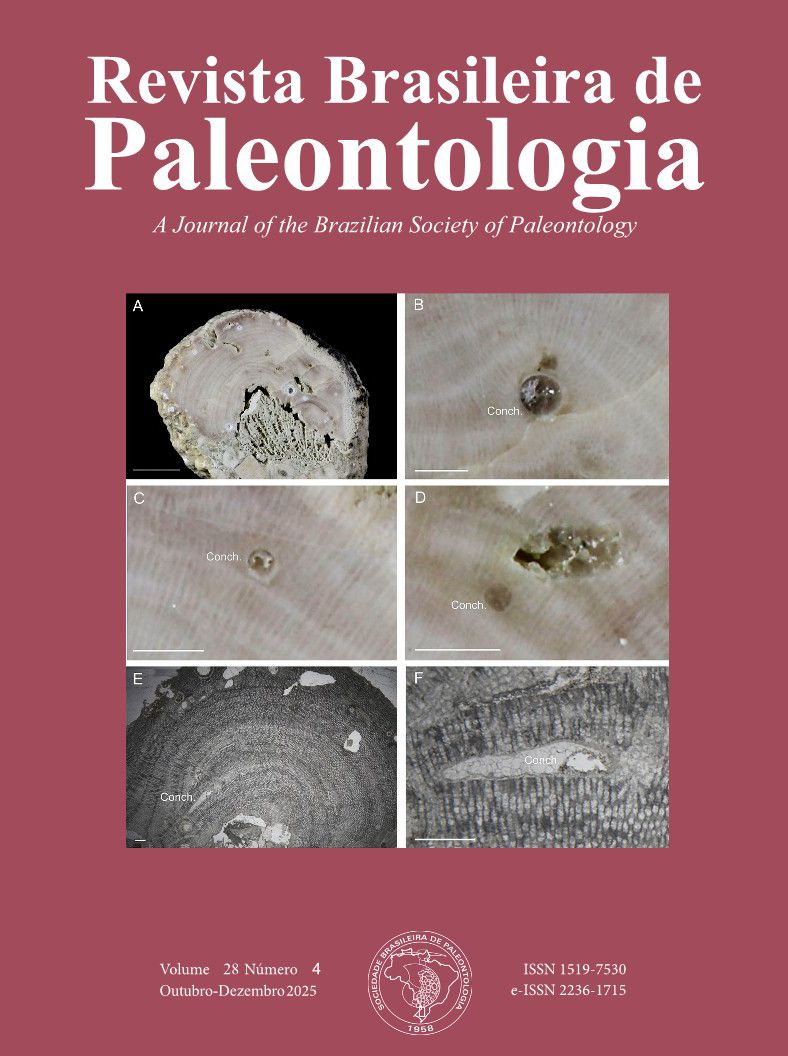
Ribeiro and Ghilardi explore the taphonomic significance of growth patterns in Orbiculoidea bodenbenderi from the Emsian of the Paraná Basin. In doing so, they offer new perspectives on preservation, skeletal accumulation, and the formation of fossil assemblages, with direct relevance to broader debates in quantitative taphonomy and temporal resolution.

Peixoto et al. investigate dinoturbation in the Cretaceous Areado Group of the Sanfranciscana Basin, Brazil, bringing new evidence to discussions of vertebrate-substrate interactions and paleoenvironmental reconstruction. By concentrating on biogenic disturbance in the sedimentary record, the paper contributes to larger questions in ichnology and paleoecology.

Corecco et al. examine the micromorphology of ziphodont archosaur teeth from the Triassic Santa Maria Supersequence of Brazil through a paleometric approach. By focusing on dental form at a fine anatomical scale, the study revisits a classic problem in vertebrate paleontology: what isolated teeth can reveal about taxonomy, function, and paleoecology in assemblages where more complete cranial material is rare.

In the scientific note, Chahud reports small canids from Cuvieri Cave, a Pleistocene locality in Lagoa Santa, eastern Brazil. Brief in format but meaningful in scope, the note expands the Quaternary mammal record of one of South America’s most important fossil regions and adds to our understanding of Brazilian cave faunas and late Quaternary biodiversity.

As we celebrate twenty-five years of RBP, we do so with the conviction that the future of paleontology depends on rigorous science, open dialogue, and an engaged community committed to understanding life’s history in all its complexity.

Prof. Matias Ritter

Editor-in-chief

Publicado: 2026-02-22

Artigos

Nota Científica

  • The small Canidae from Cuvieri Cave (Quaternary, Pleistocene), Lagoa Santa, Eastern Brazil

    Artur Chahud
    e20260573
    DOI: https://doi.org/10.4072/rbp.2026.1.0573
Ver Todas as Edições

Funded by the CNPq (process 401544/2024-9)