Taphonomic significance of growth patterns in Orbiculoidea bodenbenderi (Brachiopoda: Lingulata) from the Emsian of the Paraná Basin
DOI:
https://doi.org/10.4072/rbp.2026.1.0564Resumen
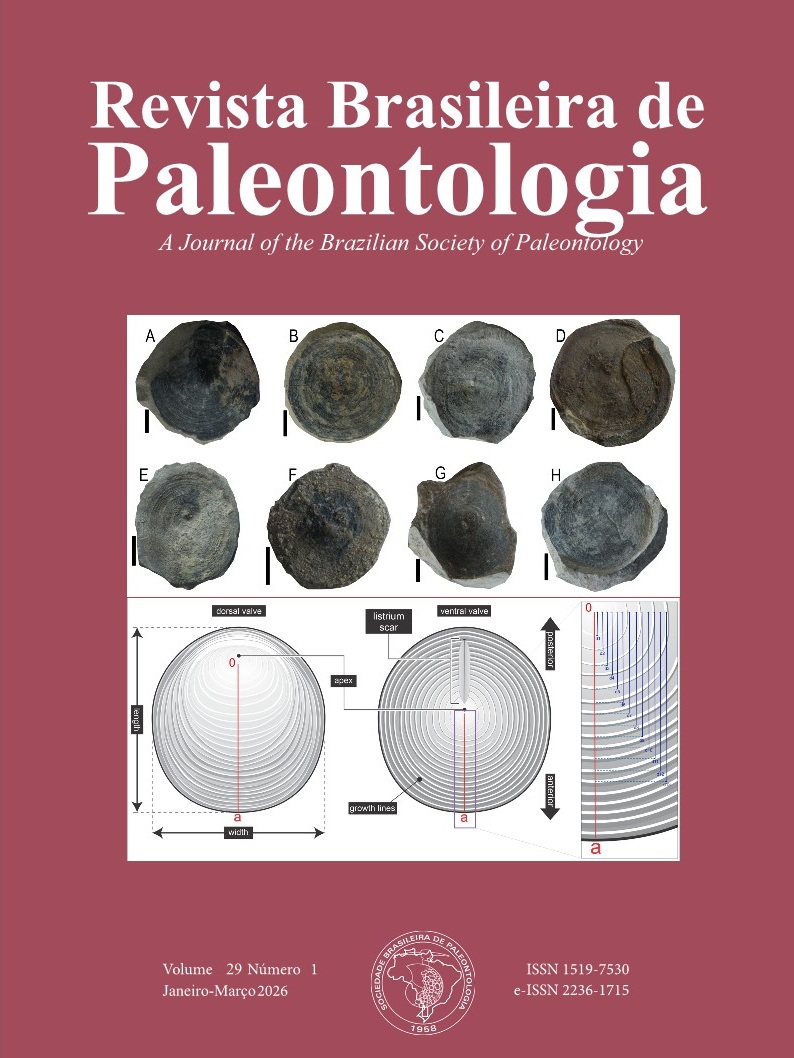
The Emsian transgression established redox conditions (anoxic to dysoxic) and drastic suppression of bioturbation in the Paraná Basin, recorded in the Jaguariaíva Member (Ponta Grossa Formation). The application of morphometric and sclerochronological analyses in Orbiculoidea bodenbenderi Clarke (Brachiopoda, Lingulata) allowed the recognition of three shell associations with high time-averaging. The first group of brachiopods had high relative growth rates in the juvenile phase (13.52% ± 2.11%), followed by a sharp decline until senescence (2.81% ± 0.8%); the second group of brachiopods presented moderate juvenile growth rates (7.44% ± 2.32%) and gradual reduction throughout life; finally, the third group exhibited residual growth since maturation (3.85% ± 1.20%), with stagnation during senescence (2.60% ± 1.08%). The coexistence of these distinct patterns in the same stratum (Maximum Flooding Surface - MFS) is incompatible with a single contemporary population, demonstrating a case of time-averaging, in which organisms from different generations and paleoenvironmental conditions were amalgamated during deposition. Slow sedimentation near the MFS, associated with reduced bioturbation under dysoxic/anoxic conditions, allowed shells to remain in the taphonomically active zone for long periods, facilitating temporal condensation and increasing the time-averaging. The O. bodenbenderi assemblage is the result of multigenerational integration, highlighting the importance of integrating ontogenetic and taphonomic data for accurate paleoenvironmental interpretations in transgressive contexts.
Keywords: Gondwana, time-averaging, morphometry, sclerochronology, taphonomic condensation.
Descargas
Publicado
Cómo citar
Número
Sección
Licencia
Derechos de autor 2026 Victor Rodrigues Ribeiro, Renato Pirani Ghilardi

Esta obra está bajo una licencia internacional Creative Commons Atribución-NoComercial-SinDerivadas 4.0.
This is an Open Access article distributed under the terms of the Creative Commons Attribution-NonCommercial-NoDerivatives license (http://creativecommons.org/licenses/by-nc-nd/4.0), which permits non-commercial re-use, distribution, and reproduction in any medium, provided that no alterations are made and the original article is properly cited. The written permission of Revista Brasileira de Paleontologia must be obtained before any commercial use and/or adaptation of the article.