Biostratinomy of Quaternary vertebrate fossils from Lajedo de Soledade, Rio Grande do Norte, Brazil: inferences regarding the processes of accumulation and deposition
DOI:
https://doi.org/10.4072/rbp.2025.3.0527Resumen
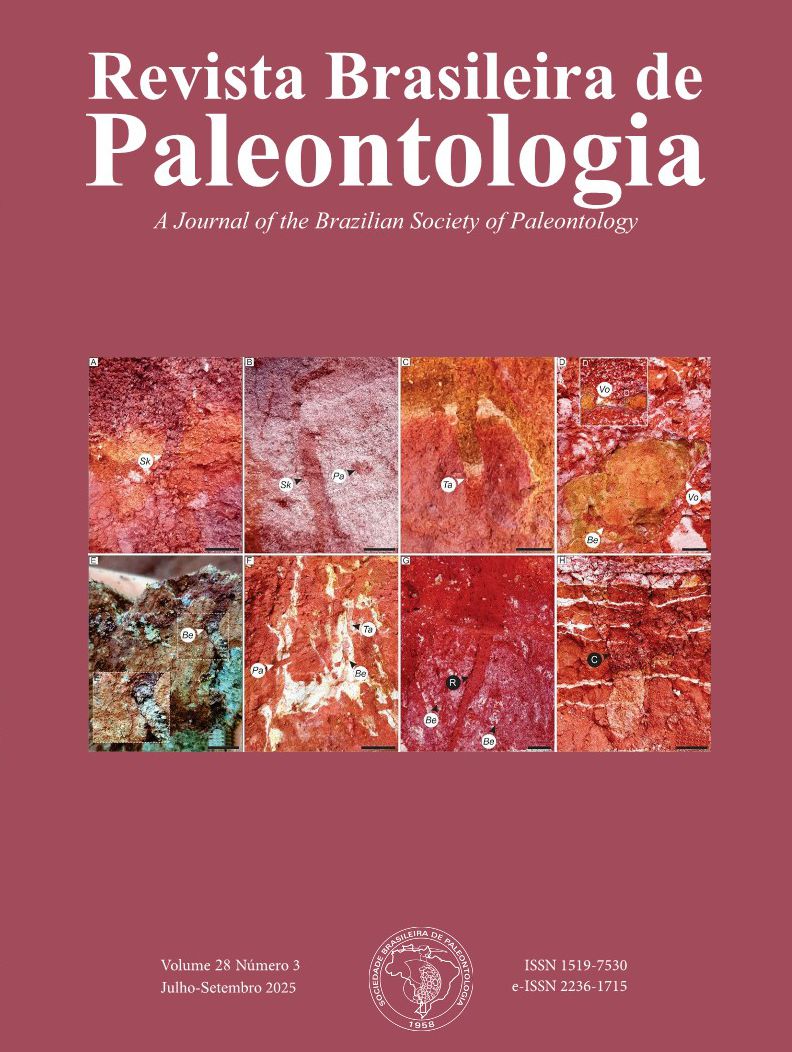
Lajedo de Soledade is a large outcrop of carbonate rock whose ravines contain abundant fossil material. This work presents the biostratinomic analysis of 896 specimens of vertebrate remains from two such ravines, namely Ravina das Araras and Ravina do Leon. The material from Ravina das Araras was collected from three different layers with stratigraphic control, whereas the Ravina do Leon material consists of a single deposit. The assemblages consist of disarticulated, microfossil elements, and are dominated by Anurans, small- and medium-sized mammals. Comparison between ravines leads to the conclusion that Lajedo de Soledade preserves elements with varied biostratinomic history that were at least partly accumulated by the action of birds of prey, and that the main factor controlling the observed patterns in the assemblages is variation in availability of water over Lajedo’s history. Comparison with other kinds of deposits in the BIR places the ravines apart from both caves and natural tanks in terms of biostratinomic patterns. It is unlikely that Lajedo de Soledade is reliable in terms of original species abundance and its use for paleoecology is limited.
Keywords: biostratinomy, vertebrate taphonomy, Lajedo de Soledade, BIR, Quaternary.
Descargas
Descargas
Publicado
Cómo citar
Número
Sección
Licencia
Derechos de autor 2025 André Cidade-da-Silva, Hermínio Ismael de Araújo-Júnior, Rodolfo Dino, Kleberson de Oliveira Porpino

Esta obra está bajo una licencia internacional Creative Commons Atribución-NoComercial-SinDerivadas 4.0.
This is an Open Access article distributed under the terms of the Creative Commons Attribution-NonCommercial-NoDerivatives license (http://creativecommons.org/licenses/by-nc-nd/4.0), which permits non-commercial re-use, distribution, and reproduction in any medium, provided that no alterations are made and the original article is properly cited. The written permission of Revista Brasileira de Paleontologia must be obtained before any commercial use and/or adaptation of the article.