
New occurrences of Late Paleozoic seeds in the Paleovalley of Mariana Pimentel, Rio Grande do Sul: taxonomy, dispersal syndromes and biostratigraphy
DOI:
https://doi.org/10.4072/rbp.2025.1.0512Abstract
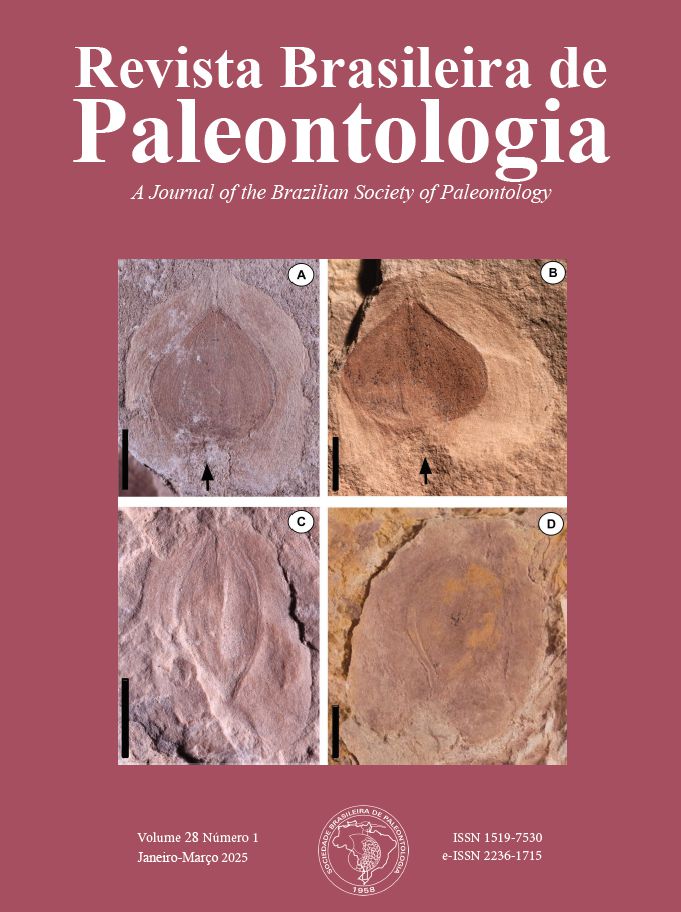
Seeds are crucial for understanding plant life cycles and environmental adaptation. This study analyzed fossil seeds from the Cocuruto outcrop (upper Itararé Group, Paraná Basin) in the Mariana Pimentel (MP) Paleovalley, identifying three genera: Cordaicarpus, Cornucarpus, and Samaropsis. A new species, Samaropsis sulriograndensis sp. nov., was erected, along with occurrences of Cordaicarpus cerronegrensis, C. brasilianus, C. truncatus, Samaropsis moreirana, S. kurtzii, and S. seixasii. Cornucarpus was identified only at the genus level. The diagnosis of Samaropsis seixasii was emended. The dispersal syndrome of each species was proposed based on size, volume, and the presence of dispersal features, with anemochory and barochory being the most common. Notably, Cordaicarpus brasilianus showed a clear affinity with glossopterids, found in connection to Arberia-type fructifications. The stratigraphic ranges of these species in the MP Paleovalley were established for the first time, highlighting S. kurtzii as a key taxon for long-distance biostratigraphy in the latest Gzhelian–earliest Asselian interval.
Keywords: seed taxonomy, dispersal syndromes, phytostratigraphy, Paraná Basin, Carboniferous–Permian transition.
Downloads
Downloads
Published
How to Cite
Issue
Section
License
Copyright (c) 2025 Raul dos Santos Prado, Juliane Marques-de-Souza, Roberto Iannuzzi

This work is licensed under a Creative Commons Attribution-NonCommercial-NoDerivatives 4.0 International License.
This is an Open Access article distributed under the terms of the Creative Commons Attribution-NonCommercial-NoDerivatives license (http://creativecommons.org/licenses/by-nc-nd/4.0), which permits non-commercial re-use, distribution, and reproduction in any medium, provided that no alterations are made and the original article is properly cited. The written permission of Revista Brasileira de Paleontologia must be obtained before any commercial use and/or adaptation of the article.